Why brokers are adding AI to support
Many client questions at a brokerage repeat: “Where is my deposit?”, “Why was my position closed?”, “What documents do you need?”, “How do I change my password?”. Clients ask them at all hours and in many languages. An AI assistant that can read the client’s own account data can answer many of these on the spot.
The goal is not to replace the support team. It is to answer simple questions quickly so people can spend time on the cases that need judgement.
Good use cases
| Use case | Example question | Data needed |
|---|---|---|
| Account status | “What is my balance and margin level?” | Account summary |
| Trade explanations | “Why was this position closed?” | One deal and its close reason |
| Funding status | “Has my deposit arrived?” | Funding request status |
| Verification | “What documents are still missing?” | Verification status |
| Platform help | “How do I set a stop loss in MT5?” | Help content only |
| Policies | “What are your withdrawal processing times?” | Published policies |
What not to automate
- Investment advice or trade recommendations of any kind.
- Placing, changing or closing trades.
- Approving deposits, withdrawals or transfers.
- Complaints, disputes and anything with legal weight.
- Conversations where a client seems vulnerable or distressed.
- Changes to personal data, such as email address or bank details.
These need a person. The assistant can still help by collecting context and passing it on, so the client does not have to repeat themselves.
Guardrails
- Scope the data. The assistant reads only the logged-in client’s own data, and only the fields needed.
- Keep it read-only. It explains; it does not act on the account.
- Ground the answers. It answers from account data and your approved help content, not from general knowledge about markets.
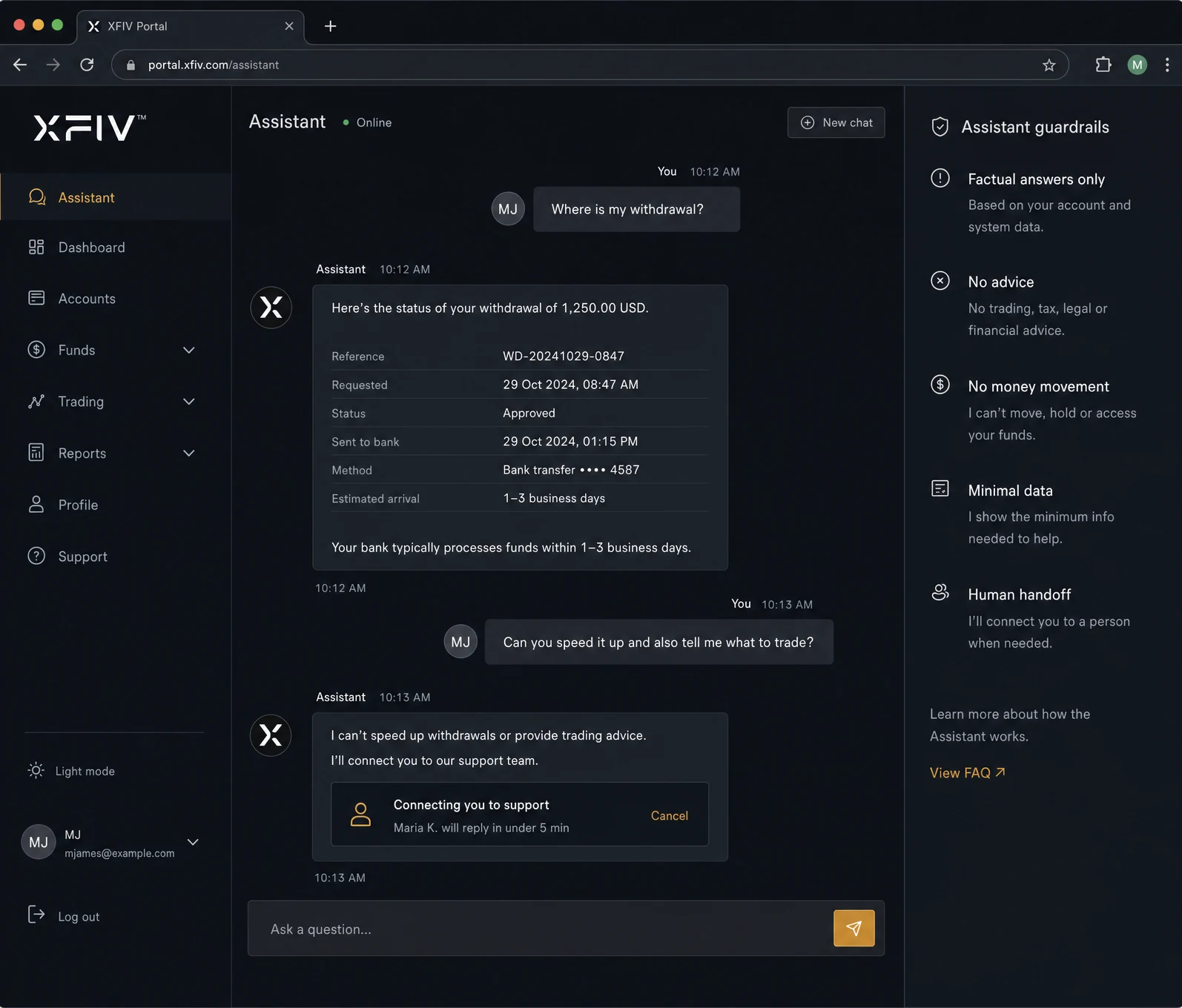
- Say no clearly. When asked for advice, it explains that it cannot give it and offers other help.
- Show who is speaking. Clients should know they are talking to an AI assistant.
- Log everything. Keep a record of conversations and the data the assistant read.
Agree these rules with compliance before launch. Requirements on disclosures, record keeping and communications vary by jurisdiction.
Designing the human handoff
Handoff is where AI support succeeds or fails. A good handoff is quick, keeps context and is easy to trigger.
When to hand off
- The client asks for a person.
- The question is in the “do not automate” list.
- The assistant cannot find the answer in the data or help content.
- The client repeats the question or shows frustration.
- The conversation mentions a complaint, legal action or a vulnerable situation.
How to hand off
- Tell the client a person will take over and what to expect, including hours if staff are not available.
- Pass the full conversation and a short summary to the agent.
- Route to the right team: support, finance or compliance.
- Let the agent see what data the assistant read.
Multi-language support
Brokers often serve clients in many countries. AI assistants can answer in the client’s language, which makes support available to people your team cannot reach in their own language. A few points to watch:
- Keep approved help content and policies available in each language you serve, so answers stay grounded.
- Keep legal disclosures in their approved translations rather than generated text.
- When handing off, include a translation of the conversation for the agent.
- Have native speakers review samples in each language.
Measuring quality
Decide what “good” means before launch, then measure it the same way every week. Useful measures:
| Measure | What it tells you | How to collect it |
|---|---|---|
| Answer accuracy | Whether answers match the account data and policies | Staff review a sample of conversations |
| Resolution without handoff | How many questions the assistant fully answered | Conversation logs |
| Handoff appropriateness | Whether it handed off when it should have | Staff review of handed-off and non-handed-off samples |
| Client feedback | Whether clients found the answer useful | Short rating at the end of a chat |
| Refusal correctness | Whether advice requests were declined properly | Targeted review of flagged conversations |
| Time to first response | How quickly clients get help | System timestamps |
Set your own baseline from the first weeks of a pilot and track change over time. Be wary of comparing your numbers with figures from other firms, since definitions differ.
A simple rollout plan
- Pick a short list of use cases from the table above.
- Write the guardrails and handoff rules, and agree them with compliance.
- Test in a sandbox with test accounts and scripted questions, including attempts to get advice.
- Run an internal pilot with staff acting as clients.
- Open to a small group of real clients and review conversations closely.
- Widen access gradually, adding use cases only when quality holds.
How the XFIV Portal agent works
XFIV Portal includes a built-in AI agent. It reads the client’s own account data, answers in multiple languages, does not give investment advice or place trades, and hands the conversation to your team when needed. Conversations and actions are recorded in audit logs. See the AI agent portal page and the XFIV Portal product page.
Frequently asked questions
Can an AI assistant give trading advice to clients?
This guide recommends against it. Keep the assistant to factual information about the client’s account and your services, and agree the boundaries with compliance.
Will AI replace our support team?
It is better seen as a first line for simple, factual questions. People still handle complaints, money movements, disputes and anything that needs judgement.
How do clients reach a person?
They should be able to ask for one at any time. The assistant should also hand off on its own when rules say so.
How do we know the answers are correct?
Ground answers in account data and approved content, review a sample of conversations regularly and track accuracy over time.