About this page
Brokers search for an alternative to an existing provider for many reasons: a change in business model, a new market, a wish to add AI features, or simply a scheduled contract review. We do not describe or rate any other vendor’s products, prices or clients here. Vendors change quickly, and the only reliable comparison is one you run yourself against current, written answers. This page helps you run that comparison well.
Start with your requirements, not a feature list
Most brokerage technology providers list similar headline features: a client area, onboarding, payments integration, an IB module, reporting and a trading platform connection. Long feature lists make vendors look alike. What separates them is how well each one fits your trading platform, your operating model and your plans for the next three years.
Before speaking to vendors, write down:
- Which trading platforms you run today and plan to run, and whether MT5 is your main platform.
- Which parts of your stack you want to replace and which you want to keep, such as your CRM, payment providers or KYC vendor.
- Your client experience goals, including languages, mobile use and any plans for AI-assisted service.
- Your integration needs: who will build on the platform, and whether you need APIs, webhooks or MCP access for AI assistants.
- Your regulatory context, which stays your responsibility whichever vendor you choose.
- Your migration constraints, such as client data you must move and dates you cannot miss.
Evaluation criteria for a brokerage technology provider
Use the table below as a scoring template. Ask each vendor to answer every row in writing, then weight the rows by what matters most to your brokerage.
| Criterion | What to look for | How to verify |
|---|---|---|
| Trading platform fit | Depth of integration with the platform you actually run, such as MT5. | A live demo against an MT5 test server; written list of supported operations. |
| Modularity | Whether you can adopt one module without taking the whole suite. | Contract terms for single-module use; reference customers using a subset. |
| Client experience | Branding control, languages, mobile behavior and self-service depth. | Hands-on trial as a client; review of a real branded deployment. |
| AI capabilities | What an AI agent can see and do, who controls permissions, and whether actions are logged. | Permission model documentation; audit log sample. |
| APIs and extensibility | REST APIs, webhooks, MCP support and documentation quality. | Read the developer docs; build a small proof of concept. |
| Security and hosting | Hosting provider and region choice, encryption, backups, access control. | Security questionnaire; architecture overview; incident process. |
| Data ownership and exit | Who owns client data, export formats and exit assistance. | Contract clauses on data return and termination. |
| Product maturity | Which modules are generally available and which are early, pilot or planned. | Written status per module; roadmap commitments in the contract. |
| Support and onboarding | Onboarding plan, support hours, escalation and service levels. | Draft onboarding timeline; service level terms. |
| Commercial model | Setup fees, recurring fees, usage-based charges and change costs. | Itemized quote for your expected volumes. |
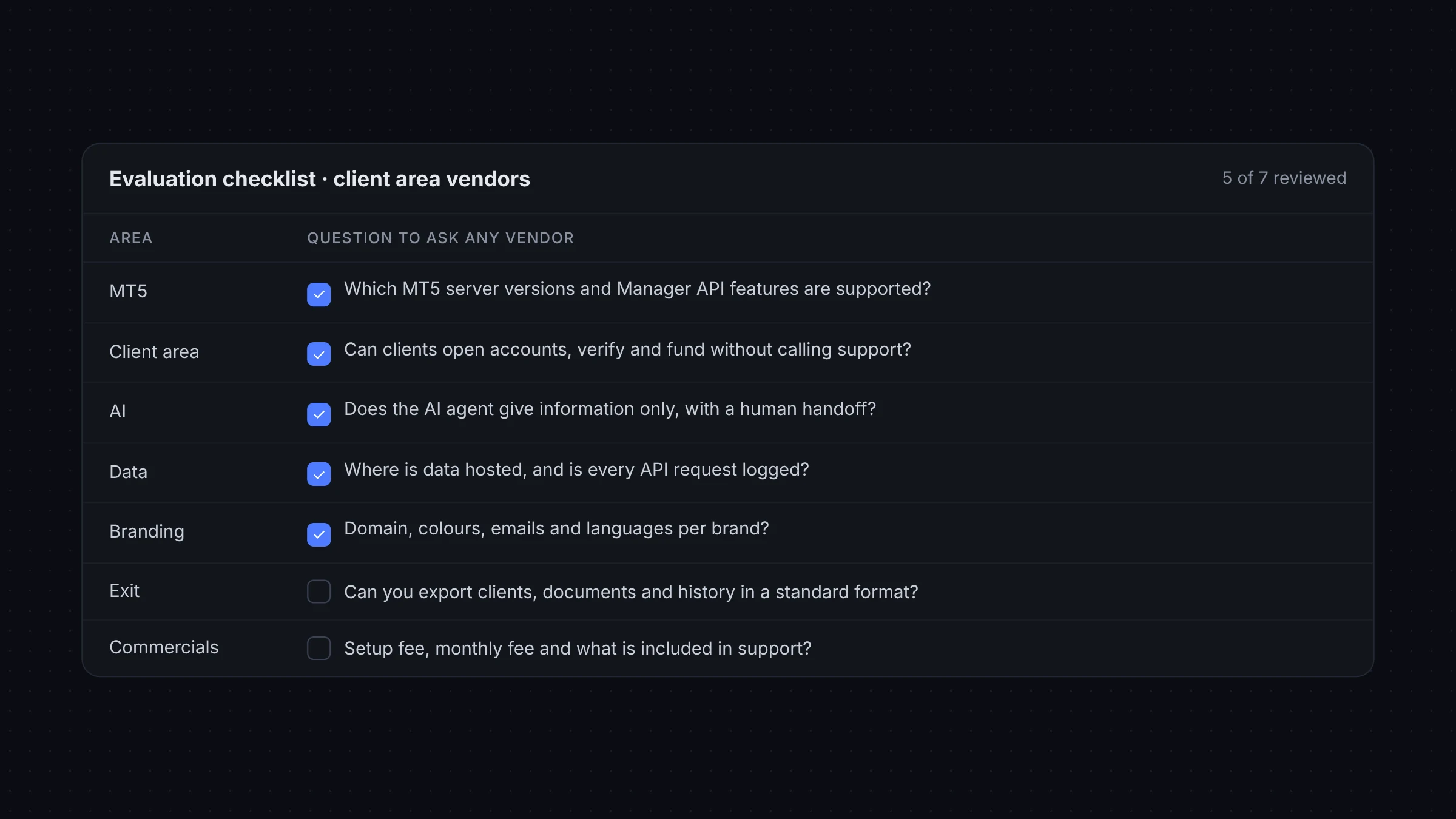
Questions to ask any vendor
These questions work for any provider you are considering, including XFIV. Ask for written answers so you can compare like with like.
- Which of your modules are generally available today, and which are in pilot or development?
- How do you connect to MT5, and what happens to our clients if that connection is interrupted?
- Can we start with one module and add others later without renegotiating everything?
- Which parts of the client experience can we brand, translate and configure ourselves?
- If you offer an AI assistant, what data can it access, who sets its permissions, and how are its actions logged?
- What APIs, webhooks or MCP endpoints can our developers use, and where is the documentation?
- Where is our data hosted, can we choose the region, and how is it encrypted and backed up?
- How do we export our data if we leave, and in what format?
- What does onboarding look like week by week, and what do you need from our team?
- Which responsibilities stay with us as the regulated broker?
Where XFIV fits
XFIV is a brokerage technology provider that builds five connected products for MT5 brokers: XFIV Portal, XFIV Trade, XFIV Copy, XFIV Connect and XFIV BrokerOS. XFIV is not a broker. XFIV may be a good fit if these points matter to you:
MT5-first
XFIV is designed around MetaTrader 5. XFIV Connect integrates with your MT5 server, and the other products build on that connection. You keep your MT5 setup; compatibility with your build is confirmed during onboarding.
An agentic client portal
XFIV Portal is a branded client area with a built-in AI agent. Clients can ask about their accounts, balances and trading history in plain language, get help with portal tasks and reach support. The agent gives information, not investment advice, and you control what data it can access.
MCP for AI assistants
Through XFIV Connect, clients can link their trading accounts to compatible AI assistants using the Model Context Protocol (MCP). Access is read-only by default, permissions are set by the broker, and every request is recorded in an audit log.
Modular adoption
Each product can run on its own or with the others. Most teams start with one product, such as Portal or Connect, and add more over time.
| Product | What it does |
|---|---|
| XFIV Portal | Branded client area with a built-in AI agent |
| XFIV Trade | White-label web trading terminal over MT5 |
| XFIV Copy | Copy and social trading with risk controls |
| XFIV Connect | MT5 integration API, webhooks and MCP |
| XFIV BrokerOS | CRM, back office, IB and reporting |
Where XFIV may not fit
An honest evaluation includes the cases where we are not the right choice today:
- You need a trading platform other than MT5. XFIV is built for MT5 brokers.
- You need a licence, liquidity, payment processing or a broker-in-a-box service. XFIV provides software only and does not provide licences or liquidity.
- You are committed to another CRM and back office and do not plan to change it. XFIV Portal and XFIV Connect can still run alongside it, but XFIV BrokerOS would not be a fit.
Running a fair evaluation
- Agree your weighted criteria internally before the first vendor call.
- Send every vendor the same written questions and the same timeline.
- Ask for a demo against an MT5 test environment, not only slides.
- Speak to your compliance team about any AI features and data flows.
- Score answers independently with at least two reviewers, then compare.
- Plan migration and exit before you sign, not after.
If you want to include XFIV in your shortlist, start with the product overview and the developer documentation, then book a demo to see the products against your own requirements.
Frequently asked questions
Is XFIV a direct replacement for B2Broker or B2CORE?
We do not make product-by-product claims about other vendors. XFIV offers five connected products for MT5 brokers, and whether they replace any existing system depends on your requirements. Use the criteria on this page and ask every vendor for written answers.
Can I move to XFIV one module at a time?
Yes. Each XFIV product can run on its own or with the others. A common first step is XFIV Portal or XFIV Connect, keeping other systems in place while evaluating the rest.
Does XFIV provide a licence or liquidity?
No. XFIV is a brokerage technology provider and is not a broker. We provide software only and do not provide licences, liquidity or hold client funds. Regulatory responsibility stays with the broker.
Is XFIV BrokerOS available today?
Yes. XFIV BrokerOS covers CRM, back office, IB and reporting for MT5 brokers. Book a demo to see it against your own setup.